
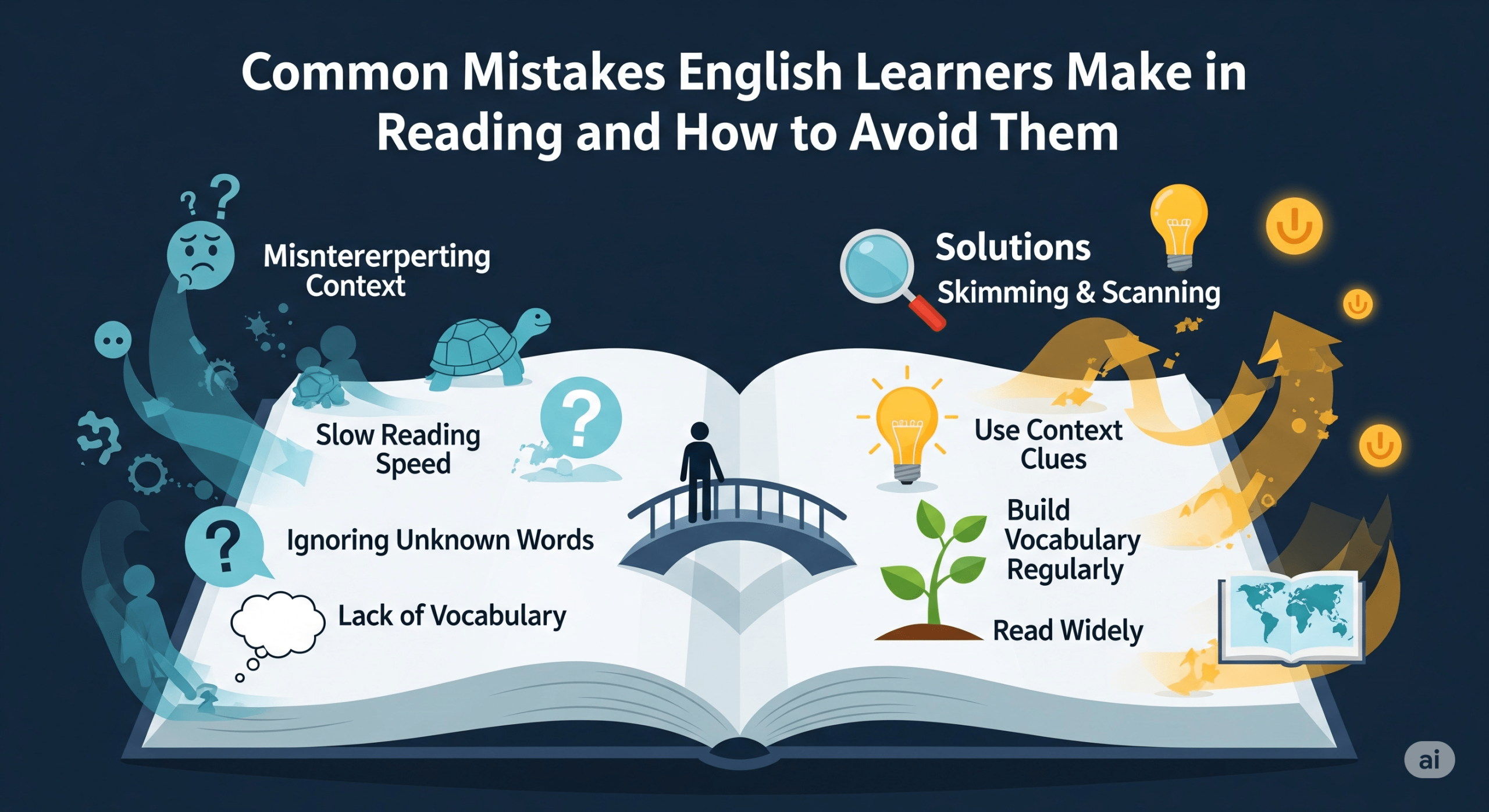
Mistake 1: Translating Every Word
Why it happens:
-
Beginners often believe they need to understand every word to understand the text.
-
Using a dictionary for every unknown word slows down reading and breaks flow.
How to avoid it:
-
Focus on the main idea first.
-
Guess meaning from context before checking the dictionary.
-
Learn high-frequency words gradually instead of memorizing everything.
Mini Exercise:
Take this sentence:
“The forest was dense, and the sunlight barely reached the ground.”
Without a dictionary, guess what dense means from context. (It likely means “thick” or “crowded with trees.”)
Mistake 2: Ignoring Text Structure
Why it happens:
-
Learners read word by word, missing the overall organization of the text.
-
This makes it harder to answer main idea or summary questions.
How to avoid it:
-
Skim the text first for headings, first sentences, and paragraph structure.
-
Note transitions: however, in contrast, therefore, moreover.
-
Recognize topic sentences in each paragraph.
Mini Exercise:
Read a short news article and underline:
-
First sentence of each paragraph (topic sentence)
-
Transition words
-
Conclusion sentence
Mistake 3: Rereading Excessively
Why it happens:
-
Learners often reread sentences multiple times to “fully understand.”
-
This wastes time and reduces reading speed.
How to avoid it:
-
Use a pointer (finger, pen, or mouse) to guide your eyes forward.
-
Accept partial understanding at first; you can clarify later.
-
Practice reading with timers to get used to forward momentum.
Mini Exercise:
Take a 200-word article. Set a 5-minute timer. Read through once, underline key ideas, do not stop for unknown words. Review only after the timer ends.
Mistake 4: Focusing Only on Vocabulary
Why it happens:
-
Learners assume vocabulary is the key to comprehension.
-
Grammar, context, and idioms are often neglected.
How to avoid it:
-
Learn to recognize sentence patterns.
-
Practice reading chunks of words instead of individual words.
-
Use context clues for unknown words.
Mini Exercise:
“Despite the heavy rain, the match continued as scheduled.”
Without focusing on each word: what does this sentence convey? (The match went on even though it was raining.)
Mistake 5: Reading Too Slowly
Why it happens:
-
Fear of misunderstanding leads learners to read word by word.
-
Subvocalization (reading aloud in your head) slows down speed.
How to avoid it:
-
Train reading in phrases (2–4 words at a glance).
-
Reduce subvocalization using a pointer or finger.
-
Practice timed reading exercises.
Mini Exercise:
Time yourself reading a 150-word paragraph. Record WPM. Repeat daily and track improvement.
Mistake 6: Ignoring Comprehension Strategies
Why it happens:
-
Learners may read the text but don’t use strategies like summarizing, predicting, or questioning.
-
This results in shallow understanding.
How to avoid it:
-
Predict: Before reading, guess what the text is about from title/headings.
-
Question: Ask yourself questions like “What is the main idea?”
-
Summarize: After reading, write a short summary in 2–3 sentences.
Mini Exercise:
Read a short story. Write three questions about it. Answer them without looking back.
Mistake 7: Not Practicing Enough
Why it happens:
-
Learners rely solely on classroom reading or occasional articles.
-
Inconsistent practice slows progress.
How to avoid it:
-
Read daily, even if only 10–15 minutes.
-
Mix materials: news, blogs, short stories, and graded readers.
-
Track progress: note WPM, vocabulary learned, comprehension scores.
Mini Exercise:
Create a reading log:
| Date | Text | Time | WPM | New Words | Notes |
Mistake 8: Avoiding Difficult Texts
Why it happens:
-
Learners stick to easy texts for comfort.
-
This limits vocabulary growth and exposure to complex grammar.
How to avoid it:
-
Gradually increase difficulty.
-
Read short sections first, then expand.
-
Focus on understanding the general idea; details will come later.
Mini Exercise:
Take a slightly advanced news article. Skim it first, highlight 5 key words, then read intensively one paragraph at a time.
Mistake 9: Ignoring Context and Cultural References
Why it happens:
-
Learners focus on literal translation, ignoring implied meaning, idioms, or cultural references.
How to avoid it:
-
Learn common English idioms.
-
Understand cultural context when reading stories or news.
-
Don’t panic—guess from overall meaning.
Mini Exercise:
“He spilled the beans about the surprise party.”
Ask: What does “spilled the beans” mean? (He revealed the secret.)
Mistake 10: Lack of Post-Reading Reflection
Why it happens:
-
Learners read and move on immediately.
-
This prevents vocabulary retention and comprehension improvement.
How to avoid it:
-
Summarize, retell, or discuss the text after reading.
-
Use new words in your own sentences.
-
Track mistakes and patterns for improvement.
Mini Exercise:
After reading an article:
-
Write a 5-sentence summary
-
Note 3 new words/phrases
-
Retell the story aloud
Recommended Daily Routine to Avoid Mistakes
| Step | Time | Focus |
|---|---|---|
| Pre-reading | 2–3 min | Predict topic, note keywords |
| Reading | 10–15 min | Focus on main idea, read in phrases |
| Post-reading | 5–10 min | Summarize, write new vocabulary, retell |
Consistency is key. Even 20–30 minutes per day will build fluency and reduce mistakes over time.