
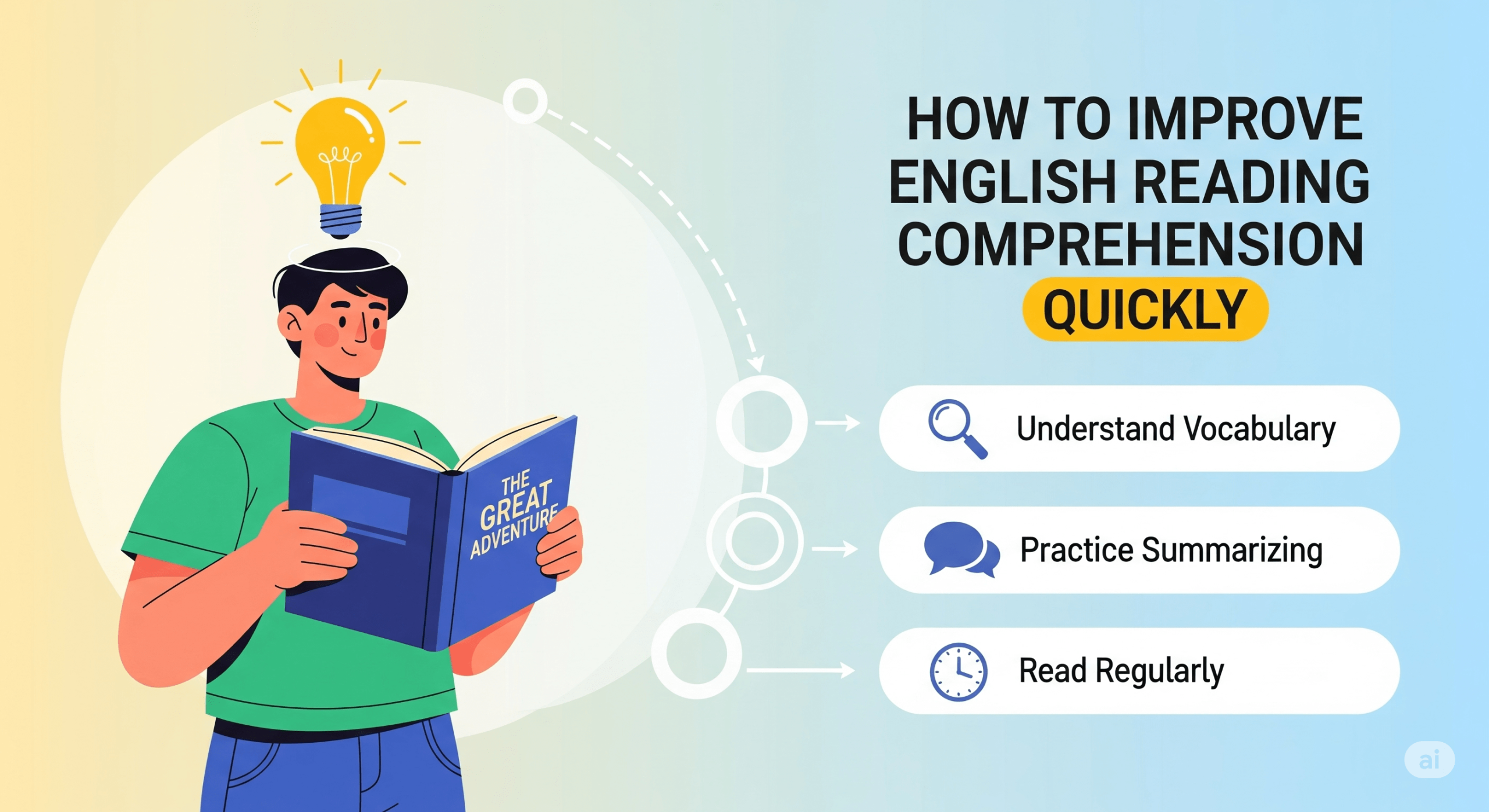
Why Reading Comprehension Matters
Strong reading comprehension is essential because it:
-
Improves Vocabulary – Understanding words in context helps you learn them faster.
-
Enhances Grammar Awareness – Seeing sentence structures repeatedly reinforces correct grammar use.
-
Builds Critical Thinking – Analyzing texts improves logical reasoning and interpretation.
-
Supports Other Language Skills – Good comprehension leads to better speaking, writing, and listening.
Without effective comprehension, reading becomes a slow, frustrating process, and learning progress is limited.
Common Challenges Learners Face
Many learners face these issues while reading:
-
Translating Word by Word – This slows comprehension and breaks the flow.
-
Difficulty Identifying Main Ideas – Learners get lost in details.
-
Limited Vocabulary – Unknown words make sentences hard to understand.
-
Poor Retention – Remembering what was read is difficult.
-
Lack of Focus – Long texts or dense materials cause distraction.
The good news is that all these challenges can be addressed with strategic reading techniques.
Step 1: Skim and Scan Before Reading
Skimming and scanning are essential skills for comprehension:
-
Skimming: Quickly read the text to get the main idea. Focus on headings, subheadings, and the first and last sentences of paragraphs.
-
Scanning: Look for specific information, such as dates, names, or key numbers.
These techniques save time and give your brain a framework before you read in detail.
Step 2: Focus on Main Ideas
Instead of understanding every word, focus on:
-
The topic sentence of each paragraph.
-
Repeated words or phrases that indicate the main idea.
-
The author’s purpose: to inform, entertain, or persuade.
Understanding the main idea helps you get the overall meaning even if you don’t know every word.
Step 3: Use Context Clues
When encountering unknown words:
-
Look at the words before and after for hints.
-
Identify the overall theme of the sentence or paragraph.
-
Guess the meaning, then check a dictionary if necessary.
This reduces interruptions and speeds up comprehension.
Step 4: Take Notes and Highlight
Active reading enhances comprehension:
-
Highlight key words and phrases.
-
Write summaries or questions in the margins.
-
Note cause-effect relationships and sequence words (first, next, finally).
These habits make it easier to remember what you read.
Step 5: Practice Regularly
Consistency is key to improvement:
-
Read short articles, news posts, or short stories daily.
-
Start with 10–15 minutes per session and gradually increase time.
-
Keep a reading log to track progress and identify areas for improvement.
Daily practice trains your brain to process English more efficiently.
Step 6: Combine Reading With Listening
Listening while reading strengthens comprehension:
-
Follow an audiobook while reading the text.
-
Listen to podcasts and read transcripts at the same time.
-
Repeat sentences aloud to reinforce memory and pronunciation.
This method helps connect written words with spoken language, making comprehension faster and easier.
Step 7: Retell and Summarize
After reading a text:
-
Summarize it in your own words.
-
Retell the story or information to a friend or teacher.
-
Focus on main ideas, key details, and vocabulary.
This reinforces understanding, memory, and the ability to explain content clearly.
Step 8: Practice With Questions
Answering comprehension questions trains your brain to focus on:
-
Details and facts
-
Inferences
-
Author’s tone or purpose
-
Vocabulary in context
Use practice books, online quizzes, or exercises from platforms like Read Mini or ReadTheory.
Step 9: Choose the Right Material
Material should match your level and interests:
-
Beginners: Short stories, children’s books, graded readers.
-
Intermediate: Blogs, news articles, simple novels.
-
Advanced: Essays, research articles, professional texts.
Enjoyable content keeps motivation high, making comprehension practice more effective.
Step 10: Stay Patient and Motivated
Improving reading comprehension is a gradual process:
-
Don’t try to understand everything immediately. Focus on progress.
-
Celebrate small milestones like finishing an article or understanding a story.
-
Mix reading genres to keep it engaging.
Motivation combined with consistent practice leads to significant improvement over time.
Recommended Tools
-
Read Mini – Structured reading passages with questions.
-
LingQ – Vocabulary in context and reading exercises.
-
News in Levels – Simplified news articles for learners.
-
Goodreads – Track progress and find recommended reading material.
These tools help learners practice comprehension in a structured and enjoyable way.