
Why Reading Comprehension Is Important
Before we look at strategies, let’s understand why comprehension matters:
-
📚 Academic success – Exams often test comprehension, not just vocabulary.
-
💼 Career growth – Many jobs require reading emails, reports, and manuals in English.
-
🌍 Daily life – From reading news to using apps, comprehension makes life easier.
-
🎓 Language improvement – Comprehension helps you naturally absorb grammar and new vocabulary.
If you can read but not understand, you’ll miss the real benefits of learning English.
1. Activate Background Knowledge Before Reading
Good comprehension begins before you even start reading. By activating your prior knowledge, you prepare your brain for the text.
✅ How to do it:
-
Look at the title, images, or subheadings.
-
Ask yourself: What do I already know about this topic?
-
Predict what the text might say.
📌 Example: If you’re about to read an article titled “Climate Change and Global Warming”, think about what you know from school, TV, or news. This makes the text easier to connect with.
2. Focus on Main Ideas, Not Every Word
One of the most common mistakes is trying to understand every single word. This slows you down and makes comprehension harder.
✅ Instead, try this:
-
Read the text once quickly to get the main idea.
-
Ignore unknown words at first—guess meaning from context.
-
Then, go back and check important vocabulary if necessary.
📌 Example: In the sentence “The politician delivered a compelling speech despite strong opposition,” you may not know “compelling,” but you can understand that it was an important speech, because of context.
3. Build Vocabulary in Context
Vocabulary is the key to comprehension. However, memorizing long word lists is not effective. The best way to learn vocabulary is in context.
✅ Effective methods:
-
Highlight new words while reading.
-
Write them in a notebook with example sentences.
-
Use flashcard apps like Quizlet, Anki, or Memrise.
-
Learn collocations (words that often appear together).
📌 Example: Instead of learning “make,” learn make a decision, make progress, make a mistake. This makes comprehension more natural.
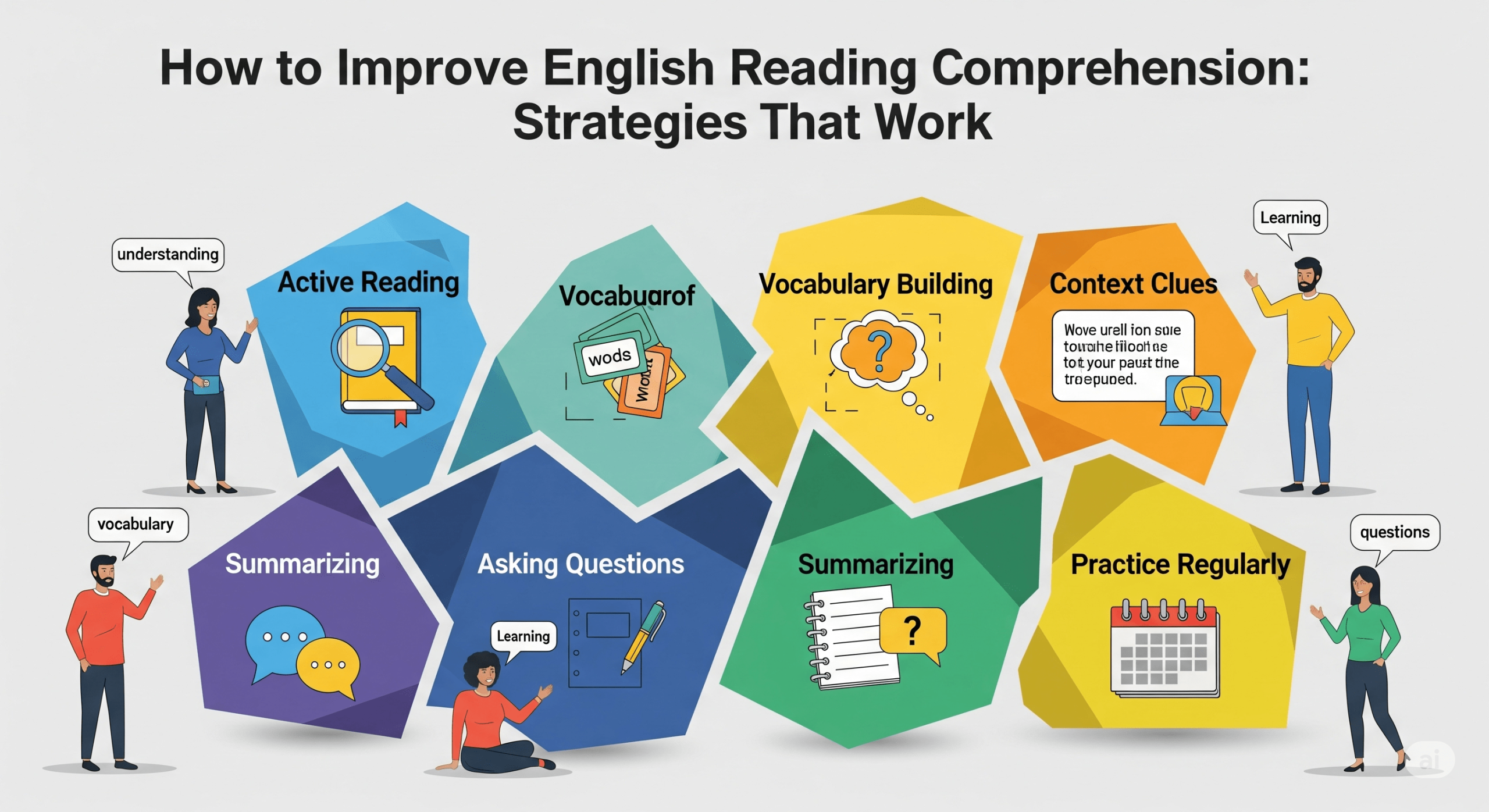
4. Practice Active Reading
Passive reading = low comprehension. Active reading keeps your brain engaged and helps you remember what you read.
✅ Tips for active reading:
-
Highlight important points.
-
Ask yourself questions: Who? What? Why? How?
-
Write short summaries after each paragraph.
-
Create a “mind map” of the text.
📌 Example: After reading a short story, summarize it in one or two sentences. This forces you to focus on the main meaning.
5. Master Reading Strategies: Skimming, Scanning, and Close Reading
Professional readers don’t use just one method—they switch between different strategies:
-
Skimming → reading quickly to get the general idea. Useful for articles, emails, or news.
-
Scanning → looking for specific details like dates, names, or numbers. Great for exams.
-
Close reading → reading carefully to understand details and analyze meaning. Best for academic texts or literature.
By practicing these strategies, you’ll train your brain to handle different types of texts.
6. Break Texts into Smaller Sections
Long passages can feel overwhelming. Breaking them into sections makes reading easier.
✅ How to practice:
-
Divide the text into short paragraphs.
-
Summarize each section in one sentence.
-
Only move on when you understand the section.
📌 Example: In a news article with five paragraphs, write one short summary sentence for each paragraph.
7. Use Comprehension Questions
Testing yourself is one of the best ways to improve comprehension.
✅ Try this after reading:
-
Write down 3–5 questions about the text.
-
Answer them in your own words.
-
Check if your answers match the text.
📌 Example: After reading a text about healthy eating, ask:
-
What are the benefits of eating vegetables?
-
What problems are caused by fast food?
-
What advice does the author give?
8. Read Different Types of Texts
If you only read one type of text, your comprehension will stay limited. Instead, read a wide variety of materials:
-
📰 News articles → formal English, current vocabulary.
-
📖 Novels & short stories → narrative style, cultural expressions.
-
🎓 Academic texts → advanced vocabulary, exam practice.
-
💬 Blogs & forums → informal, conversational English.
The more genres you explore, the better your comprehension becomes.
9. Improve Concentration and Focus
Reading comprehension requires focus. If your mind is distracted, you won’t understand.
✅ Improve focus by:
-
Reading in a quiet place.
-
Setting a timer for 20 minutes of focused reading.
-
Taking short breaks between sessions.
-
Gradually increasing reading time.
Think of reading as exercise for your brain—the more you practice, the stronger your focus becomes.
10. Summarize and Retell the Text
One of the most powerful strategies is summarization. If you can explain the text in your own words, you truly understand it.
✅ Ways to practice:
-
Write a short summary in English.
-
Retell the text to a friend.
-
Record yourself explaining the text.
📌 Example: After reading an article about technology, try explaining it as if you’re teaching it to someone else.
Common Mistakes to Avoid
Many learners make mistakes that slow down their progress:
❌ Translating every single word into their native language.
❌ Choosing texts that are too difficult.
❌ Ignoring comprehension questions.
❌ Reading without engagement (passive reading).
Avoiding these mistakes will save you time and frustration.
Daily Practice Routine for Better Comprehension
Here’s a simple daily routine you can follow:
-
Read 15–20 minutes every day.
-
Highlight 5–10 new words and learn them in context.
-
Summarize the text in 3–5 sentences.
-
Answer comprehension questions (make your own if needed).
-
Review vocabulary weekly with flashcards or apps.
If you follow this routine consistently, you’ll notice improvement within weeks.