
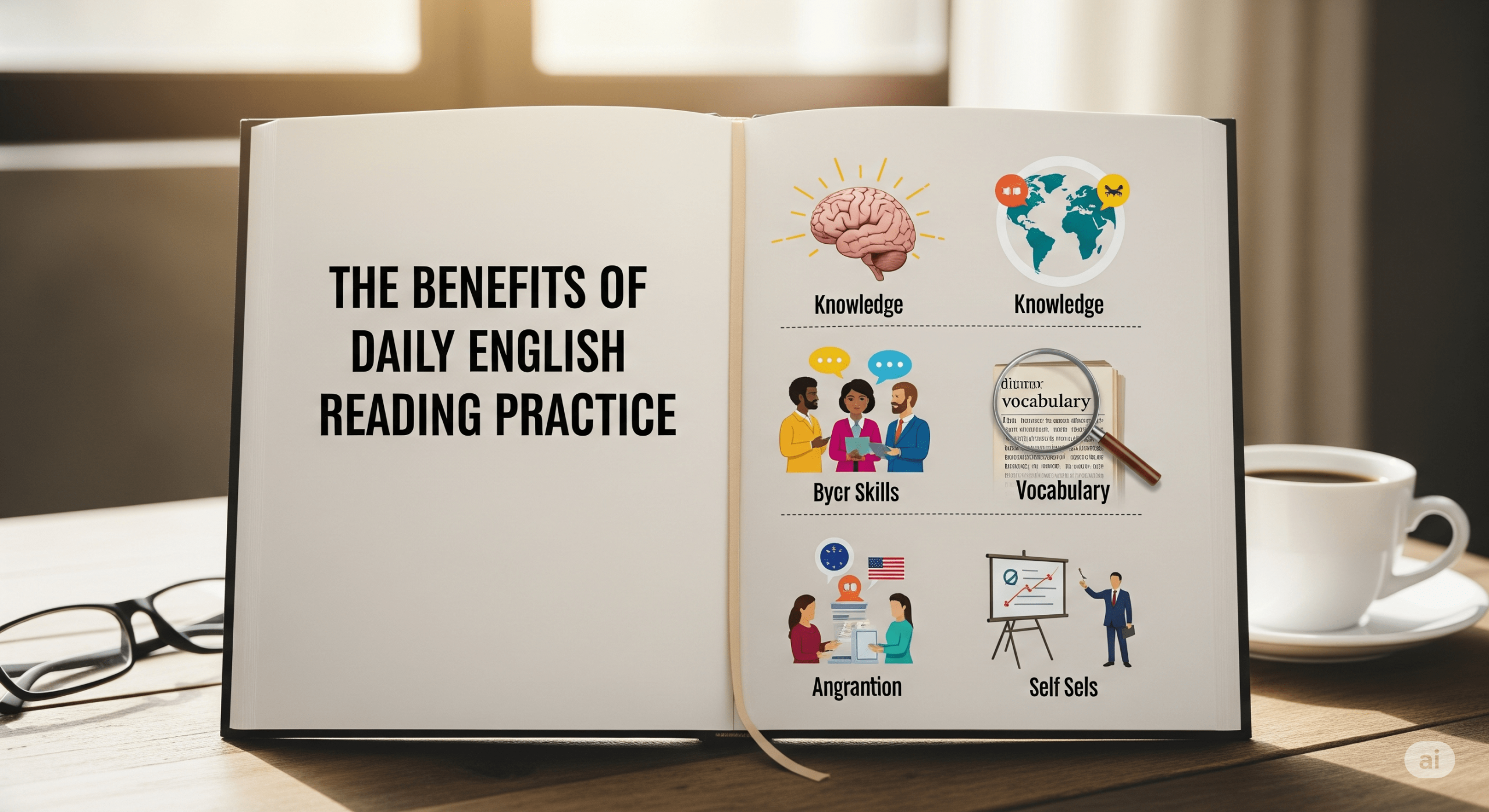
1. Expands Vocabulary Naturally
One of the biggest challenges in learning English is building a strong vocabulary. Daily reading provides a constant flow of new words in context.
-
You don’t just learn a word; you also see how it is used in real sentences.
-
Repetition across different texts reinforces memory.
-
Collocations (word combinations) become clear through natural exposure.
👉 Example: Reading the word “make a decision” in several articles teaches you the correct phrase, not just the individual word “decision.”
2. Improves Reading Comprehension
Daily exposure to texts trains your brain to process English more efficiently.
-
You learn to identify main ideas faster.
-
You recognize sentence structures more easily.
-
You become comfortable with complex passages.
👉 Over time, what once seemed difficult becomes natural and automatic.
3. Strengthens Grammar Without Memorization
Traditional grammar study can feel boring and mechanical. But daily reading allows you to absorb grammar rules subconsciously.
-
You see verb tenses in real use.
-
You notice how prepositions, articles, and connectors work.
-
Sentence patterns become familiar without needing endless exercises.
👉 For example, reading stories in the past tense helps you internalize past tense usage more effectively than a grammar chart.
4. Boosts Fluency and Thinking in English
When you read in English every day, you train your brain to process information directly in English rather than translating.
-
This reduces hesitation and translation delay.
-
Fluency improves because English becomes part of your daily thought process.
-
You start recognizing phrases and expressions instantly.
👉 The more you read, the faster your brain switches to “English mode.”
5. Enhances Writing Skills
Reading and writing are deeply connected. By reading daily, you automatically improve your writing.
-
You learn sentence variety and flow.
-
You pick up academic and professional writing styles.
-
You see how transitions and connectors are used in real texts.
👉 Writers often say: “Good readers become good writers.” This is especially true in language learning.
6. Builds Cultural Understanding
Language and culture are inseparable. Daily reading exposes you to cultural references, idioms, and expressions that are rarely explained in textbooks.
-
You understand humor, metaphors, and real-life examples.
-
You gain insight into traditions, history, and lifestyle.
-
You become more confident in conversations with native speakers.
👉 Reading newspapers, blogs, or novels gives you not just language skills, but also cultural awareness.
7. Improves Focus and Consistency
Reading every day trains not only your language skills but also your discipline.
-
It builds a learning routine that feels natural.
-
Small daily habits create long-term success.
-
Even 10–15 minutes a day adds up to hours of practice each month.
👉 Remember: consistency beats intensity. Reading 10 minutes daily is more effective than reading for 3 hours once a week.
8. Provides Enjoyable Learning
Perhaps the greatest benefit is that daily reading can be enjoyable rather than stressful.
-
You can choose topics you love: sports, travel, technology, stories.
-
It doesn’t feel like “study” but rather entertainment.
-
Enjoyment makes learning sustainable in the long run.
👉 Reading what you love keeps you motivated and consistent.
Practical Tips for Daily Reading
-
Start Small: Begin with 10 minutes per day. Increase gradually.
-
Choose the Right Material: Pick content slightly above your level.
-
Mix Text Types: Articles, short stories, blogs, and news.
-
Track Your Progress: Note down what you read each day.
-
Combine with Listening: Use audiobooks or podcasts alongside texts.