
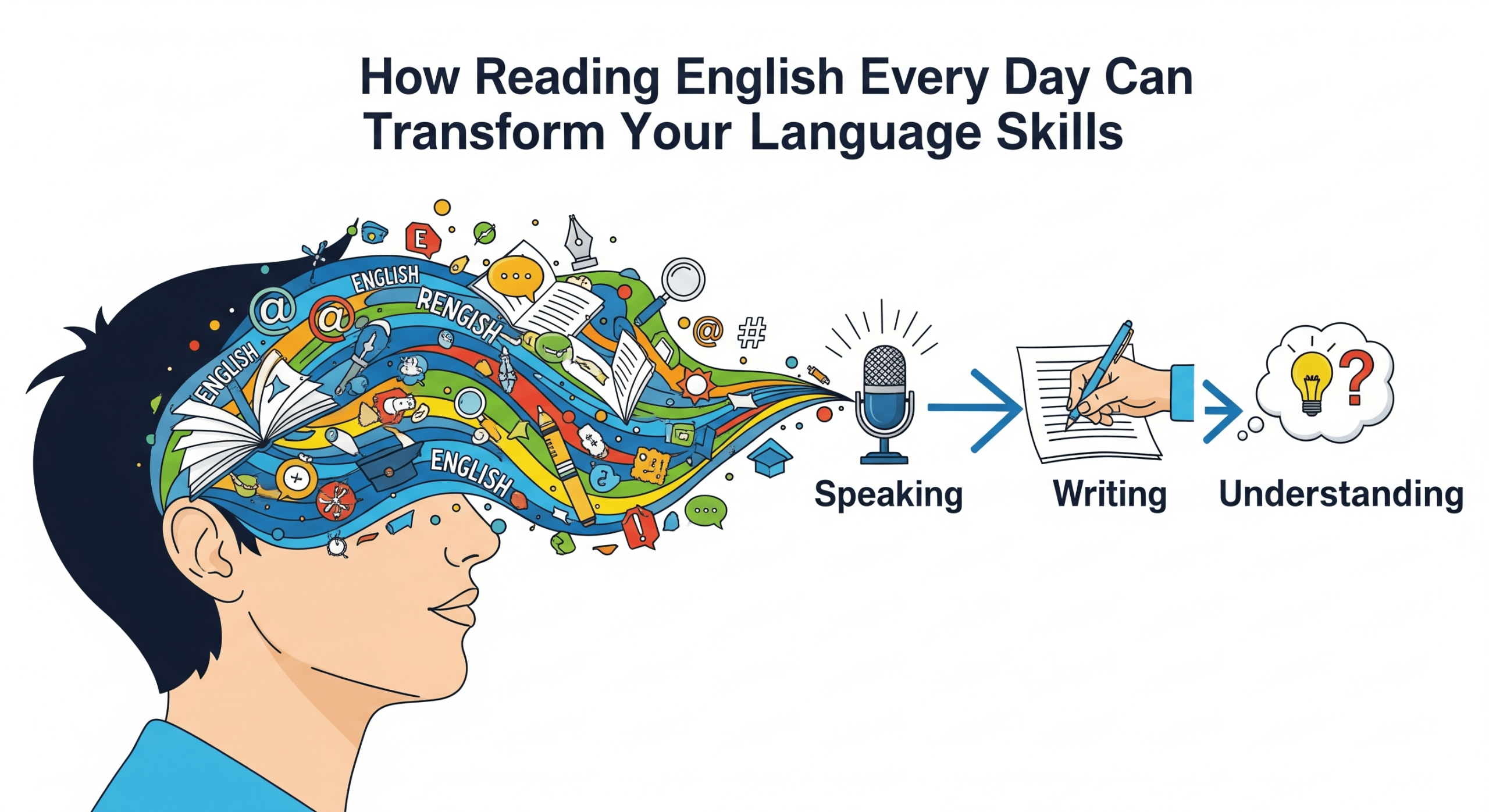
The Benefits of Reading English Every Day
1. Vocabulary Expansion
One of the most obvious benefits of daily reading is learning new words in context. Unlike memorizing word lists, reading exposes learners to vocabulary naturally.
-
Seeing words in full sentences helps you understand meaning and usage.
-
Repetition in different contexts reinforces memory.
-
Learning idiomatic expressions, phrasal verbs, and collocations becomes easier.
2. Improved Grammar and Sentence Structure
Daily exposure to correct English sentences improves your grammar subconsciously:
-
You notice how tenses, prepositions, and connectors are used.
-
Complex sentence structures become familiar, helping with writing and speaking.
-
Patterns of language become intuitive, reducing the need to think consciously about grammar rules.
3. Enhanced Comprehension Skills
Regular reading helps learners:
-
Identify main ideas quickly.
-
Understand details without translating word by word.
-
Infer meaning from context, improving overall comprehension.
Over time, this leads to faster reading and better understanding of complex texts.
4. Boost in Fluency
Reading aloud or silently every day improves reading fluency:
-
Your brain processes words more efficiently.
-
Pronunciation and rhythm are reinforced if reading aloud.
-
Thinking in English becomes easier, which also aids speaking and writing.
5. Cultural Awareness
Many English texts include cultural references, traditions, and social norms. Daily reading exposes learners to:
-
Different ways of thinking and expressing ideas.
-
Common idioms, metaphors, and humor.
-
Cultural context that enhances understanding of media, literature, and communication.
How to Make Daily Reading a Habit
1. Set a Specific Time
Choose a consistent time every day for reading. Even 10–20 minutes is effective if done daily.
-
Morning coffee, lunch break, or before bed are popular options.
-
Habit stacking can help—pair reading with an existing routine.
2. Choose Engaging Material
Pick content that interests you:
-
News articles – for current events and modern vocabulary.
-
Short stories – for narrative skills and entertainment.
-
Blogs or opinion pieces – for conversational and informal English.
-
Books adapted for learners – for gradual progression.
Engaging material keeps motivation high.
3. Start Small and Increase Gradually
If you’re new to daily reading:
-
Begin with short texts (1–2 pages or a single article).
-
Focus on understanding main ideas rather than every word.
-
Gradually increase length and complexity over time.
4. Combine Reading With Other Skills
-
Listening: Follow audiobooks or podcasts while reading the text.
-
Writing: Summarize articles or stories in your own words.
-
Speaking: Discuss what you read with friends or teachers.
This integrated approach improves all aspects of language learning.
5. Take Notes and Review
-
Highlight new words and expressions.
-
Make a vocabulary journal with definitions and example sentences.
-
Review regularly to reinforce learning.
Overcoming Common Challenges
Even motivated learners may face obstacles:
-
Limited time: Break reading into short, manageable sessions.
-
Difficulty understanding: Choose simpler texts or graded readers at your level.
-
Loss of motivation: Mix genres, topics, and formats to stay interested.
Consistency is more important than the length or difficulty of each session.
Recommended Daily Reading Materials
-
Graded readers: Oxford, Penguin, Macmillan – perfect for all levels.
-
News sites: BBC Learning English, VOA Learning English.
-
Short stories: O. Henry, Roald Dahl, or modern online stories.
-
Blogs or hobby-related articles: Travel, food, technology, or lifestyle blogs.
Mixing formats keeps reading fresh and engaging while targeting multiple skills.
Tips for Maximizing Learning
-
Read aloud occasionally to improve fluency.
-
Skim and scan before detailed reading to get main ideas.
-
Retell or summarize what you read in English to reinforce memory.
-
Track progress using a journal or digital app.
Small, consistent efforts add up to significant improvement over time.
Reading English every day is one of the most effective ways to transform your language skills. It strengthens vocabulary, grammar, comprehension, fluency, and cultural understanding. Even short, daily sessions provide meaningful progress when combined with active reading techniques and integrated practice.