
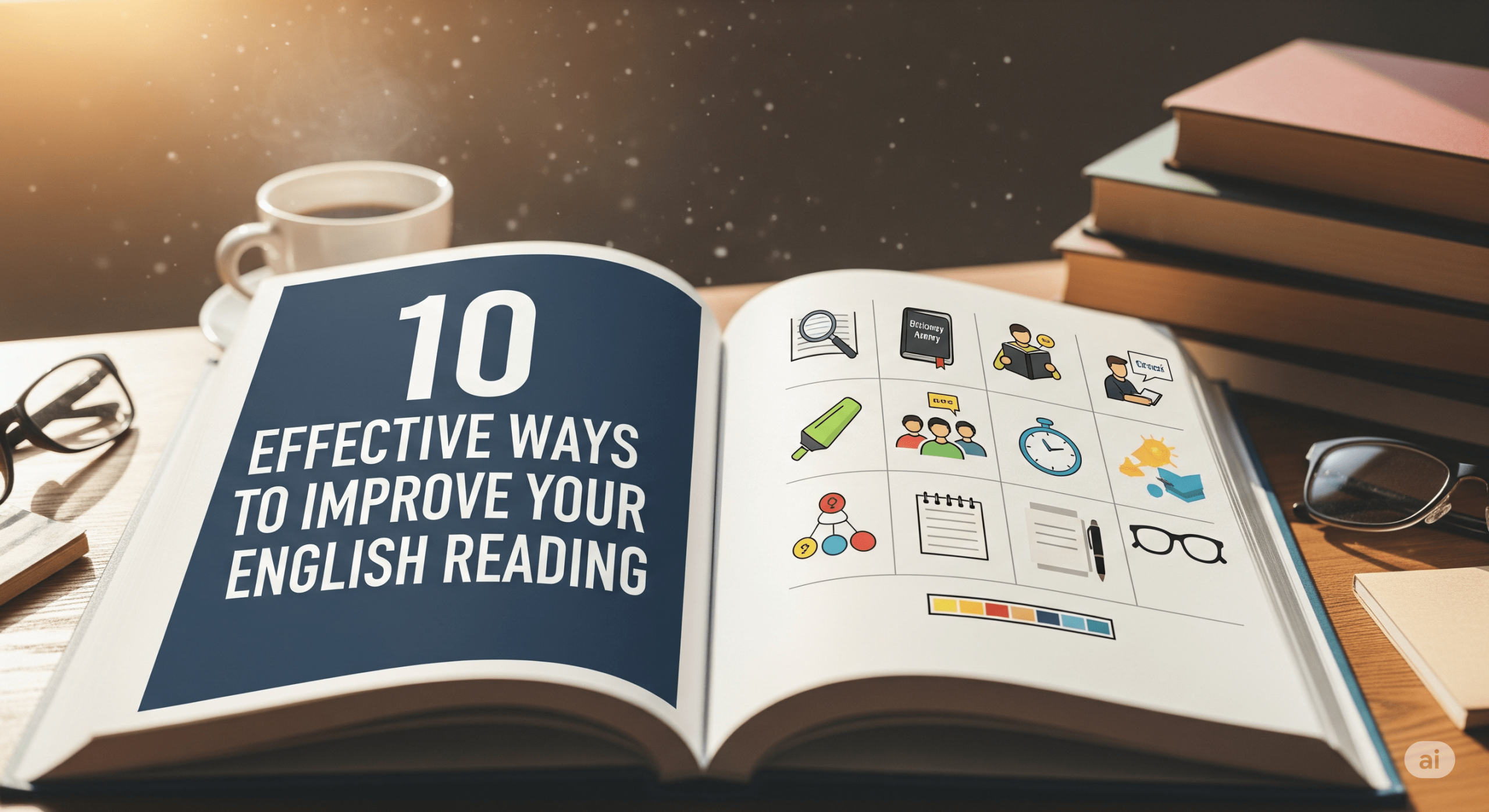
1. Read Every Day (Consistency Over Intensity)
Reading fluency develops through habit, not random study sessions. Even 10–15 minutes per day can produce visible results in just a month.
Example routine:
-
Morning: read a 200-word news article with breakfast.
-
Evening: read one page of a graded reader before bed.
👉 Small actions every day are more powerful than reading one long text once a week.
2. Choose the Right Level
Reading material that’s too hard leads to frustration, while texts that are too easy don’t challenge you.
Rule of thumb: If more than 1 in 20 words is unknown, choose something easier.
Best sources for beginners:
-
Graded readers (Oxford, Penguin, Cambridge)
-
Simple English news websites (e.g., BBC Learning English, News in Levels)
-
Short stories written for ESL learners
Mini-task: Pick one short story today. Circle only the words you don’t know. If you circled more than 10 words on one page, find an easier text.
3. Use Skimming and Scanning
Different texts require different reading styles:
-
Skimming: read quickly for the general idea (headings, first lines, conclusion). Perfect for news articles or when you need the “big picture.”
-
Scanning: look only for specific details (dates, numbers, names). Useful for exams or when searching for a fact in a long text.
Try this exercise:
Take a 300-word article. First, skim it in 30 seconds and write down the main topic. Then, scan it for 3 specific details (e.g., “What year is mentioned? Who is quoted?”).
4. Guess Words from Context
A common beginner mistake: stopping to translate every unknown word. This slows you down and kills motivation.
Instead:
-
Look at surrounding words.
-
Ask: “Is this word positive/negative? Is it an action, object, or description?”
-
Check if the text still makes sense without knowing the exact word.
Example sentence:
“The shop was so crowded that I could barely move.”
Even if you don’t know crowded, words like shop and move suggest it means “full of people.”
👉 Guess first, confirm later with a dictionary.
5. Build a Personal Vocabulary Journal
Don’t write down every single word. Focus on high-value vocabulary.
Smart method:
-
Write the word: achievement
-
Add an example sentence: Her biggest achievement was learning English in one year.
-
Add your own sentence: Passing the exam was a big achievement for me.
Pro tip: Review 5–10 old words before reading something new. This strengthens long-term memory.
6. Mix Extensive and Intensive Reading
-
Extensive reading: long, easy texts you enjoy. Aim: fluency, confidence, and speed.
-
Intensive reading: shorter, more difficult texts. Aim: accuracy, vocabulary, and grammar.
Example plan:
-
Monday to Friday: extensive (easy story or article, 15 minutes).
-
Weekend: intensive (exam passage, analyze structure, underline grammar, check vocabulary).
👉 Together, these two methods create both speed and depth in your English.
7. Read Aloud (Short Sections)
Reading aloud builds pronunciation, rhythm, and memory. It also forces you to notice punctuation and sentence flow.
Exercise:
Take a short paragraph (100–150 words).
-
Read silently for understanding.
-
Read aloud slowly once.
-
Read aloud again with better intonation.
-
Record yourself—compare pronunciation.
8. Summarize in Your Own Words
One of the best ways to test comprehension: explain the text briefly.
Example activity:
-
Read a 400-word article.
-
Without looking, write a 3-sentence summary.
-
Check back: Did you capture the main point, key detail, and conclusion?
👉 Summarizing forces your brain to organize ideas, which is essential for exams and real-life communication.
9. Time Yourself and Track Progress
Progress is invisible unless you measure it. Keep a reading log:
| Date | Text | Words | Time | WPM | New Words | Summary |
|---|---|---|---|---|---|---|
| 2025-08-17 | Short story | 350 | 12 min | 29 | 5 | “A boy learns…” |
-
Words Per Minute (WPM): words ÷ minutes.
-
Check WPM weekly. Even a small increase shows improvement.
10. Read What You Love
Motivation is the most important factor. If you’re bored, you’ll quit.
Ideas by interest:
-
Sports fan → ESPN English articles
-
Tech lover → TechCrunch or Wired
-
Travel enthusiast → Lonely Planet blogs
-
Fiction reader → Short stories or novels at your level
👉 Passion makes reading fun, and fun makes it sustainable.
Common Mistakes to Avoid
-
Translating everything: slows progress.
-
Starting too hard: discourages beginners.
-
No routine: random study = random results.
-
Huge word lists: impossible to review.
-
Reading without purpose: always set a small goal (e.g., “find the main idea”).